
6 Signs Your Website Is Driving Customers Away (and What to Do Instead)

Gauging your website’s capacity to attract, engage, and convert customers can be difficult. Yes, you can (and should) follow performance metrics to see if you’re generating sufficient traffic and conversions. But positive numbers can sometimes be deceiving. And some instances of subpar web performance can even hide behind great numbers. To be frank, you can see various signals that your website is driving customers away
So, instead of just adding Google Analytics to your WordPress website and taking the occasional glance at the metrics, you’ll want to learn how to interpret those signals and boost performance.
This guide outlines some of the most prominent signs that your website is driving customers away. Furthermore, it provides tips for fixing common performance issues with effective design, copywriting, brand positioning, and conversion-optimization tactics.
Web Traffic Is High, But Conversions Are Low
A website that attracts many visitors can have tremendous potential—but only if it’s capable of turning visits into conversions. So, if your web traffic is high but conversion rates are low, then there’s definitely something in your online presence that’s driving customers away.
So, how do you fix this issue? Well, the first thing to do is assess your site’s ability to convert new customers against industry standards.
The Unbounce Conversion Benchmark report is an excellent resource to consult, as it measures median conversion rates (the all-industry median is 6.6%, in case you’re curious) across several verticals. Essentially, if your CR is significantly lower than whatever is relevant for your field of expertise, but you still get lots of website traffic, you’ve got some work cut out for you.
Naturally, there are a few potential reasons this is happening on your website:
- Your homepage content might be doing a subpar job at communicating customer value.
- Your landing pages might not be sufficiently relevant to your target audience—a crucial conversion obstacle, as 81% of consumers actively ignore irrelevant marketing messages.
- If you’re running paid ads that are getting lots of clicks but web visitors aren’t converting, you might need to better align the copy in those advertisements with on-site content and what you can actually do for your ideal customers.
One of the best methods to overcome this web performance killer is to optimize your WordPress site to better communicate relevant customer value.
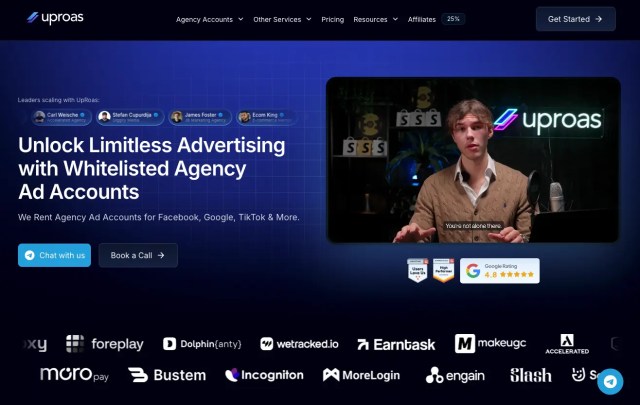
For inspiration on what this can look like, check out Uproas. This business uses several opportunities to help web visitors immediately understand the benefits of its services. The primary value proposition addresses customer value. The subheading clarifies what the brand does. And the hero section explainer video goes into sufficient detail on exactly what the business does, why its services are valuable to its ideal clients, and even whom they are or aren’t for.
High Bounce Rates
For most websites, high bounce rates are a negative signal (though not in all cases—specifically for short-form informational content). But how do you know whether your site’s bounce rates are good or bad?
The best thing you can do is look at industry benchmarks. For example, CXL discovered that in the food & drink industry, the average bounce rate exceeds 65%. For real estate, however, it’s closer to 44%.
Of course, a precise answer on how you’re performing may be slightly more difficult to acquire. Nevertheless, investing in web and UX design tactics that minimize bounce rates is always a good idea. To do that, however, you need to first understand why web visitors arrive and then immediately leave a website.
According to research, several prominent causes can lead to high website bounce rates.
For instance, web users form brand impressions (which determine their brand perception and purchase intent) in as little as 50 milliseconds upon landing on a site. Leave a negative impression, and they’re almost guaranteed to leave.
Furthermore, Google discovered that bounce rates are proportional to page load times—when load times go from 1s to 10s, the probability of a bounce increases by a whopping 123%.
Then, of course, there’s the question of mobile responsiveness. Adobe found that 30% of web users would stop interacting with a content page that’s not displaying properly on their current device.
Finally, it’s worth noting that accessibility is becoming increasingly important to web users. More than 70% of disabled users will abandon a website they find difficult to use—a significant portion of your potential audience, as approximately 16% of the world’s population might require some form of digital accommodation.
The good news is that accounting for all of these conversion obstacles is very doable with WordPress. In fact, something as simple as choosing a minimalist theme for your online presence could really push the needle on your site’s load speed, accessibility, and responsiveness.
For inspiration on what great technical site performance looks and feels like, you can check out Manitobah Mukluks—a site that looks and works just as well on mobile as it does on desktop.

High Scroll Depth But No On-Site Navigation
Another signal that your site may be driving customers away is a low Views Per Session metric despite high Scroll Depth values. What this combination of KPIs means (in lay terms) is that your web visitors are looking at your website content. However, they’re not convinced enough to further explore your offer (or even convert).
Admittedly, there are several potential reasons why your website is failing to engage customers.
- Trust is a key factor for consumers evaluating brands to buy from. For several years in a row, 88% of people have said that brand trust is an important pre-purchase consideration (along with product quality and value for money). So, if your web visitors don’t find a reason to trust your business when they land on your site, they’re very unlikely to consider converting.
- If you’re seeing high scroll depth but each session ends on the same page, the culprit may be a lack of CTAs. Essentially, as they move through the sales funnel, consumers need guidance and reassurance regarding which steps to take to reach their goals. Fail to provide this guidance with user-centric calls to action, and your prospects might not comprehend what to do next to resolve their pain points.
- Your site may be driving customers away because your on-page content is too complex to ensure proper comprehension. Web user behavior data doesn’t just show that most people scan web pages (instead of reading word-for-word). There’s even a direct correlation between readability levels and landing page conversion rates, suggesting that user-friendly copy and layout significantly elevate site performance.
With this in mind, it’s not only important to immediately engage your web visitors’ attention so that they feel compelled to explore your offer. It’s equally essential to show they can trust your brand, provide clear guidance on steps to take to solve their pain points, and ensure high on-page content comprehension.
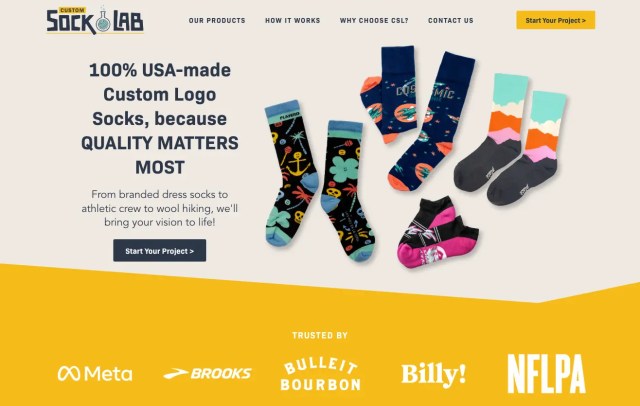
The Custom Sock Lab homepage does all of these things with great success. It immediately establishes brand credibility with powerful trust signals. It also explains how its service works in easy-to-understand terms (along with visuals). Plus, it tells web visitors exactly what step to take to start creating a custom order.
High Cart Abandonment Rates
The biggest issue with your site’s performance may not be its capacity to communicate value or even get visitors interested in your offer. Instead, the reason it’s not converting may be high cart abandonment.
Take a look at research on how often (and why) shoppers fail to follow through with their shopping decisions. According to the Baymard Institute, 70.22% of people who add an item to their carts don’t complete their purchase. And the reasons this happens vary.
In addition to a lack of consumer confidence, website errors, and simply not being ready to buy, there are a few prominent causes of cart abandonment you should pay attention to.
For starters, extra costs—like shipping—tend to turn away around 40% of people. Slow delivery is just as important for consumers browsing solutions.
Then, there’s the question of how complex a checkout process is. If it takes too long (or if the website requires account creation), a significant portion of people will choose not to buy.
Of course, it’s also worth noting that most shoppers want easy returns, price transparency, and convenient payment methods.
So, if your site has a high cart abandonment rate and you want to boost sales, it’s a good idea to remove these common website conversion barriers from your online presence.
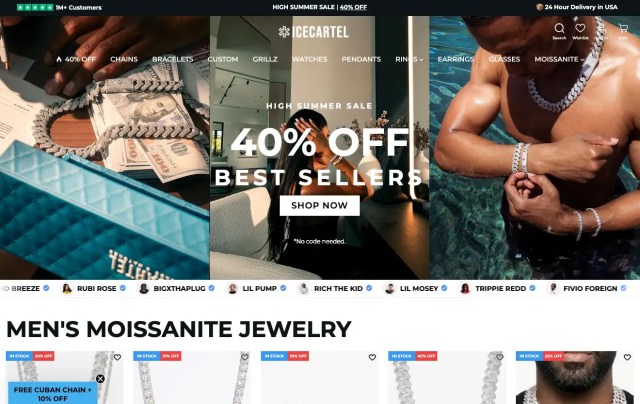
For inspiration on how you can do it, check out IceCartel. The brand clearly states that it offers 24-hour delivery in the USA. It then takes further steps to ensure high-intent leads actually complete their purchases. This includes regularly offering discounts and incentives, highlighting buy now, pay later payment options, and using plenty of social proof to maximize customer confidence.
Plenty of On-Site Movement, But No Conversion
So far, we’ve covered the possibility that your site is attracting leads but failing to engage, resulting in low views per session. But what if on-site navigation is not the issue? What if your leads are looking at multiple web pages, yet still failing to convert?
Well, there are two potential causes of this type of web user behavior.
The issue driving customers away may be a lack of brand trust. If you feel this might be the case, the best thing you can do is to optimize all product and service pages for credibility.
However, it’s also possible that your web visitors aren’t finding what they need to resolve their pain points. And that’s a far more serious conversion barrier. Its main culprits can differ. Nevertheless, they would usually include poorly designed website navigation or product discovery systems.
According to research from 2022, 37% of e-commerce web visitors fail to convert due to poor navigation or layout. And if you also consider that 80% of web visitors abandon a purchase due to a poor search experience, it becomes evident that facilitating productive on-site movement should be at the top of your list of conversion-optimization priorities.
You can start by using clear, customer-centric navigation menu labels. Furthermore, you can employ homepage product page links for items in your inventory you know your ideal customers would be interested in. Finally, don’t hesitate to utilize advanced product discovery systems.
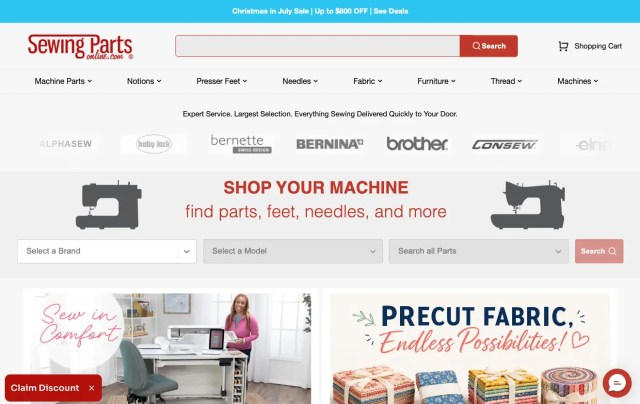
Sewing Parts Online, for example, uses a filter-powered product search system that helps shoppers quickly find the exact spare parts they need instead of forcing them to browse thousands of items in the brand’s inventory.
Low Rate of Returning Visitors
Lastly, one of the most powerful signs that your site is failing to engage visitors and earn your target audience’s trust is seeing sufficient web traffic but a low rate of returning visitors.
In truth, the reasons this might happen vary hugely. You could be dealing with a pricing issue or failing to differentiate your offer in a competitive industry. Then again, you may be just not doing enough to communicate the value of your solutions. Or, you might be failing to earn your web visitors’ trust.
There’s another potential barrier to conversion stopping you from turning web visits into sales. If you’re investing in marketing or paid advertising, you might be seeing plenty of success in grabbing consumers’ attention. But if you’re not investing in retargeting campaigns, much of that engagement may be wasted money. Not least because most people need at least eight brand touchpoints before being ready to commit to a purchase.
With this in mind, don’t just focus on building product awareness. It’s equally important to build relationships with your target audience and actively incentivize leads to continue interacting with your brand.
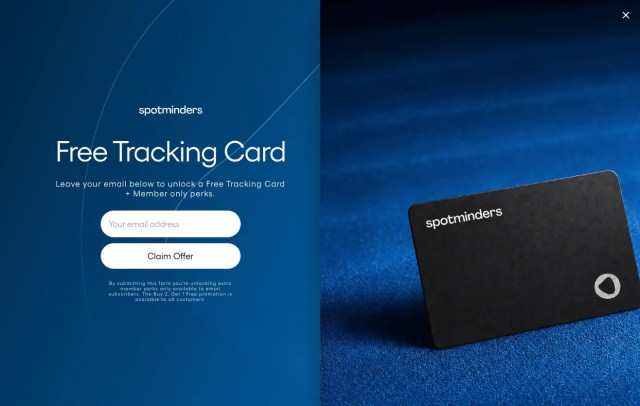
If you check out Spotminders, you’ll find that this is precisely what the business does with its discount popup. The brand’s tactic is to engage first-time web visitors with the promise of a mystery gift. This tactic works not only because it gives something to potential customers, hoping it will drive them to convert. The gift is tied to a lead-generation element—it asks consumers to leave an email that Spotminders can use to get first-time web visitors to continue engaging with the brand and visiting its website until they feel confident enough to complete a purchase.
Wrapping Up
Building a high-performing website doesn’t have to be difficult. But you do have to know what you’re doing. And one of the biggest mistakes business owners make is failing to notice the signals that their websites are driving customers away.
The performance issues covered in this guide are a good foundation for identifying potential conversion obstacles and removing them from your online presence. Of course, to ensure exceptional sales outcomes, it’s crucial that you continually measure performance. That way, you’ll easily notice negative signals before they’ve become a problem. Plus, you might get a few good ideas for how to further boost sales by proactively improving site design, usability, and technical performance.
Author’s bio:
Natasha is a lady of the keyboard and one hell of a geek. She has been working for and collaborating with individual clients and companies of all sizes for more than a decade. Natasha specializes in writing about design, branding, digital marketing, and business growth.